I wanted to share this amazing mosaic floor that I saw while recently traveling in Caesarea, Israel. Normally, I share photos, but I felt video makes it easier to see the size and scale.
Showing posts with label Culture. Show all posts
Showing posts with label Culture. Show all posts
Monday, January 9, 2017


Thursday, May 31, 2012
Botanical Garden: Palmengarten in Frankfurt
Sometimes I take a notebook, sit on a bench, and write.
Here are a few photos I've taken over the past couple years.
 |
| Palmengarten and the entrance building |
 |
| Spring bulbs. The lawns are filled with color during April and May |
 |
| An autumn view of the lake. A waterfall is to the left and underneath is a cavern. |
 |
| Flower in front of one of the garden halls |
 |
| Rowboats on a lake in Palmengarten |
 |
| Small greenhouse--this is one of the smallest in Palmengarten. Most greenhouses are very large halls. |
 |
| One of the many statues that are carefully placed in the gardens. |
 |
| Palmenhouse--one of the large buildings filled with plants. This one is filled with tropical plants. The ceiling is about 40 feet above the floor. |
I also enjoy seeing the various birds and their babies. Most are waterfowl (such as swans, ducks, moorhens, geese--brown European geese and bar-headed geese, and a heron) but there are also many other birds including blackcaps, pigeons, crows, magpies, dunnocks and more. I've also seen rooks while walking to the gardens.
Here are two bird photos:
 |
| Bar-headed geese in Palmengarten. (They are stunningly beautiful.) |
 |
| Gray Heron at the lake. Normally these turtles don't have to share their sunny log. The other side of the lake has rowboats and paddle boats. |
Sometimes after I walk through the gardens with my family, we drop by Siesmayer (restaurant/cafe/confectionary shop) and buy some treats. I highly recommend visiting Siesmayer if you are ever in Frankfurt!

The box has plastic windows: brilliant marketing!

My favorite is the chocolate framboise--a gluten free chocolate-raspberry cake, with a pistachio on top! Yum! I'll miss this when I move away.

A few more of their desserts.
Tuesday, April 17, 2012
Doors--like the cover of a novel--are an invitation to look inside
I always wonder what is behind closed doors—especially fascinating and unique doors.
 |
| Door in Bruges, Belgium |
 |
| Art Nouveau entrance in Brussels, Belgium |
This long cord makes me want to pull on it and hear what the doorbell sounds like.
 | |
| Long cord, to left of door, is what one pulls to ring the bell. |
Some places don't have doors, but only openings, such as this stick house in Keukenhof Gardens in Holland. It reminds me of the story of the Three Little Pigs.
 |
| Stick House--I'm in the photo so you can see the scale |
 |
| Photo taken in Bruges, Belgium. |
Just like a great cover or opening page of the novel, a door is an invitation to peek inside.
 |
| Front of Art Nouveau house in Brussels, Belgium |
 |
| Detail of door. I'm standing in front. |
 |
| Stained glass windows from inside of house. |
I took these photos on a recent trip we took to the Netherlands and Belgium. (Neither country is that far of a drive from Frankfurt.)
Friday, March 9, 2012
View From My Desk: Wrecking Ball (movie)
Here is what I see when I look out my window:
Yes, the view from my desk can be distracting at time.
They've been tearing down this building for over 6 months. Some days the BOOMS and BEEPS are so loud that I hear all the noise even when the window is shut. I've been amazed how hard it is to rip apart a building.
Thursday, December 29, 2011
Smallest Library I've Seen -- Frankfurt, Germany
This has to be one of the world's smallest libraries.
It is definitely smaller than the phone booth library in England.
This tiny library is the close to where I live.

This bookshelf library can be accessed from either side by opening the glass doors. There are ten shelves, five on each side. The sign in German, when translated says, "open book closet." It is an official Frankfurt am Main City Public Library and is always open.
Of course, since this is Germany, books are borrowed on the honor system. Take a book and bring it back when you've finished reading.
I looked inside and scanned the titles. They are all in German and some of the books looked very old! I pulled one out to look at it's printing date: 1926!
Another angle of this library.

Libraries, whether large or small, whether the books are in English or another language, are one of my favorite places in the world.
Monday, December 19, 2011
Fairy Tale House in Michelstadt
I rounded the corner in Michelstadt when visiting their Christmas Market and saw this amazing building.
Characters from various Grimms' tales are painted on the outer walls of this traditional fachwerk house.
 |
| Characters on this side of the house include Hansel and Gretel (top), Bremen Town Musicians (center), Little Red Riding Hood (right), and Cinderella with the prince (left)-the 2nd panel of the story. |
 |
| Detail of Bremen Town Musicians and Little Red Riding Hood. (Her hood has faded from a brighter red, but see the wine and bread in her basket?) |
Here I'm standing in front of another side of the building.
 |
| Bottom right is the first panel of Cinderella with birds. Above is the Frog Prince, and to the left is a dwarf, carrying a lantern. I'm not certain which tale he is from, as there are a couple possibilities. |
 |
| Three panels that tell the story of Puss in Boots. Left, the cat is with a man with a horn; center, a girl and boy pass by; right is Puss in his boots. |
 |
| Details of Puss in Boots |
 |
| Details of The Frog Prince |
And last--here is a view of the house, with part of the Christmas Market in the foreground.

May your holidays be filled stories.
Happy Holidays.
Monday, August 15, 2011
Culture and Stories: Thoughts on the TED talk by Elif Shafak: The politics of fiction
I’m intrigued by culture and fiction and especially the place where they intersect. My fascination with cultures began when I was a child reader. I loved reading books that took me into other times and to other places, places I never dreamed I might have a chance to visit. I grew up and through a series of events and choices, I became a global nomad who moves every couple years to a different country. Crossing into other cultures is part of my reality, and it comes with a unique mix of challenges and joy and discovery. Now, as a writer, my questions about cultures (and how one moves between them) enter my work. So anytime a writer talks about story and culture, I'm interested.
Elif Shafak, an international author, gave a TED talk where she discusses identity and stories and boundaries and cultural ghettos. She crosses, or as she puts it, she commutes between cultures. (After listening to her talk, I want to read her novels.)
Her talk is also available on the TED site (with transcript and translations) here, plus the TED site also has a nice bio.
How do we write our stories?
How do we read?
Do we cross boundaries and explore the world, or do we stay in our safe, small community?
Each place has its own stories and fiction, yet the stories of each place exert influence on other places. We can learn all sorts of information and “facts” from nonfiction and history books and the news, but it is through fiction that we can, for a short period of time, truly enter and experience another person’s life and other cultures.
Story is a way to experience the world. As Shafak says, stories “connect all humanity.”
Here are some other links to people and blogs that talk about culture and fiction: Adichie Chimamanda, Papertigers.org and the author, Uma Krishnaswami.
Tuesday, July 26, 2011
Tour Paris with a Story App! Conversation with Sarah Towle about her StoryApp Tour
 Sarah Towle, founder of Time Traveler Tours, is a writer and ex-pat who lives in Paris. Today is launch day for her StoryApp Tour, Beware Madame la Guillotine. (This link takes you to a preview. I've never used an app, but found it fun to preview with my computer.) Typically, I look to books for stories, but I also enjoy stories in many other places such as film, stage, and oral storytelling. Apps are fun and interactive, plus what a great idea for a tour. I wanted to learn more about Sarah's approach to telling stories, so asked her to join me here.
Your app, Beware Madame la Guillotine: A Revolutionary Tour of Paris, tells a story and is also a tour to some of the sights in Paris. Sarah, this is a wonderfully innovative approach to storytelling.
What is your app tour/story about?
Beware Madame la Guillotine is the story of the French Revolution, a seminal moment in history, told by a lesser-known historical character who lived at that time and whose actions helped shape that time. The narrator – and tour guide – is Charlotte Corday, a 24-year-old convent-school girl who was driven to murder. Her victim: the radical journalist, Jean-Paul Marat.
Charlotte blamed Marat for the Revolution’s turn to terror and execution of King Louis XVI. She traveled to Paris from Caen, Normandy, spent a few days at the Palais Royal learning everything she could of Marat’s habits, then bought a kitchen knife, tracked Marat to his home, gained entrance under false pretenses and stabbed him to death as he lay soaking in the bath. She was imprisoned at the Conciergerie before losing her head at the base of Mme la Guillotine.
As Charlotte spins her yarn, she reveals the story of the Revolution and takes you on a personal journey from the Palais Royal on the Right Bank to La Conciergerie on the Ile de la Cité into the sights and sounds of the Paris of her time. Along the way, map challenges, brainteasers and hunts for historical treasure bring this important part of Paris’s past to life.

Charlotte’s is one of several tales of creative non-fiction that I’ve written focusing on Paris history. As a reader, I’ve always found it more enjoyable to access history through the stories of those who lived it. As a traveler, I’ve always preferred to follow the ghosts whose footsteps preceded mine. So the original idea was to marry story with history to create itineraries that, taken together, would provide an engaging sweep of Paris’s past for school groups and families traveling together.
The sweep begins with Roman Paris and continues to the roaring 20s, the period entre les guerres.Of all these eras, the French Revolution posed the greatest challenge. I was daunted by it, the most important yet most difficult period of French history to synthesize for anyone, much less a young reader. So, I decided to start here. I figured if I could successfully capture the Revolution, I would certainly be able to manage the rest.
Besides, as soon as I discovered Charlotte, it was love at first sight. She’s a very compelling character!
What special things or effects are you able to do with an app that you couldn’t do with text alone?
As an app you can listen to Charlotte narrate her own story aloud as you walk along and/or look around at your surroundings. In the print iteration, the user had to assume the role of Charlotte and stop to read at each new location. The kids who piloted the print version felt this was too much like school. I found that it just plain took too long. It really bogged the story down. With audio narration, you are more effectively transported to Charlotte’s world.
Questions, map and trivia challenges can be responded to in the app with a simple tap on the screen. In the print version, you had to go searching for an answer key. And this really limited the types of questions that could be asked.
In the app the user can elect to dig deeper into this or that topic, or not; turn the text on to read while listening; or turn the audio off altogether and just read. As the author I’ve provided you with various elements that interact with both story and surroundings and that serve to enhance Charlotte’s narration. But how you choose to use these elements is up to you. The story experience, therefore, is not exactly linear. Although there is a beginning, middle and end to Charlotte’s tale, the journey you take as a user/reader isn’t necessarily straight. And your own interaction with the story can change depending on whether you are using the app to tour Paris or reading it on your trip to or from Paris. It can be consumed in myriad ways.
Many potential readers aren’t able to visit Paris and walk around with this app tour? Is it also set up as a virtual tour?
Not yet, but the idea of repackaging the story as a virtual tour is definitely something I’ve been turning over in my head, and more, for some time. The technology is certainly available to create a virtual tour for use in the home on your personal computer, on your tablet or – and I find this idea particularly exciting – on a classroom smartboard.
But first things first. As I am currently a company of one, I thought it best to start with one StoryApp Tour in one language on one device. Assuming Charlotte’s tour to the French Revolution for iPhone and iPod Touch proves sufficiently successful, I plan to put out a second bilingual (French-English) version of the app for both iOS and Android. I then have other stories, as I mentioned above, waiting to be produced as StoryApp Tours, while I also put in motion the virtual tour idea.
Unfortunately, unless I win the lottery, that’s still a few years away.
What other app tours do you have planned?
I have two others written and in various stages of illustration:
The story that precedes Charlotte’s takes you to the gardens of Versailles in the heyday of the Ancien Regime, the era of King Louis XIV, XV and XIV, with the Chief-Botanist-to-the-King, a descendant of France’s real-life Indiana Jones. His stories of danger, loyalty and betrayal over what today are for us simple everyday garden plants and flowers, will cause your heart to race and your stomach to churn.
And speaking of churning stomachs, the story that follows Charlotte’s is told through the eyes of a gravedigger who, facing starvation, worked to move the over-crowded skeletal remains of central Paris’ pestilent church graveyards to the underground former rock quarries on the then southern outskirts of the city. Once in power, Napoleon Bonaparte ordered our gravedigger and his compatriots back to work to gussy-up the remains of 6 million dead so, as in Rome, the seat of his empire could have a spectacular Catacombs.
And a fourth StoryApp is currently in the works. It takes you to Paris of the Romantic era, to Hausmannian Paris, the Paris most of us know today, through the lens of one of the world’s first photographers, Nadar. He lived a long life, surviving five governments and three revolutions and he knew and took pictures of all the famous creative people of his day. His stories are legion. (As are the stories other have to tell about him.)
For more information about Sarah Towle’s StoryApp Tour, visit her website, TimeTravelerTours.
Beware Mme la Guillotine: A Revolutionary Tour of Paris will be available from Tuesday 26 July at a 20% discount the first week. You don’t have to be in Paris to buy it, play with it and post a review to the App Store. Save it on your phone and give it a go when you’re next in Paris!
Thank you, Sarah for joining me today.
Also, she is running a kickstarter campaign to get these storyapp tours up and running. Her kickstarter site can be found at this link: Beware Madame La Guillotine, An Interactive Story App Tour.
Note: Other interviews and information are available from the following sites:
"Why I write Apps for Teens and Tweens" at Time Traveler Tours.
"From Print to Digital Media: Why I made the Shift" on Laurel Zuckerman's Paris Weblog.
"Special Report--Time Traveler Tours presents Beware Madame la Guillotine" at An Alien Parisienne where the blogger talks about taking the tour.
"Revolutionary Paris Tour with Mme Guillotine" at Bonjour Paris: the Definitive Guide to Paris
Tuesday, July 5, 2011
Revising -- through a different lens
A photo-journey about revision:
Revising is like exploring castle ruins: walking through arch after arch, or wandering up towers or down dark tunnels where you can't see a thing, or choosing to take a right or left turn. Explore everywhere. It is okay to get lost. (Actually, it's expected.) That is part of the journey.
 German castle ruins
Revising is sometimes like using a sundial on a cloudy day. No shadow to give any clue of the time, and no sun to give any sense of direction.
 Wall sundial on the outside of a medieval church (1300s)
Keep eyes open when revising. Notice objects that are not on the trodden path and look for what is not expected. The clues in the manuscript can be the key to unlocking difficulties in a revision. After all, a stone shot by the enemy's catapult can make a very nice garden ornament.
 Castle garden with a catapult stone in the foreground
Revising is not only re-envisioning, it is also mixing the very old and the very new.
 600 year old houses and the modern day skyscrapers
Enjoy the revision journey. Although revising at times means wandering, getting lost, scrambling in the dark, dealing with the unexpected, and asking question after question while searching for solutions, there are glorious moments when one should pause and enjoy the view.
 Castle towers
Monday, June 20, 2011
Summer Solstice Scrawl Crawl 2011
June 21st.
Summer solstice, the longest day of the year.
Here in Frankfurt the sun rises at at 5:15 and sets at 21:39 (9:39 pm).
Dawn is at 4:30 and dusk at 10:24 pm.
(An aside--Gaisma is my favorite site for info like this. Iceland, where I lived for a couple years is light all night!! It was my favorite time of the year there.)
What is a Scrawl Crawl?
It's a day where writers and illustrators participate in an "event where individuals create something speedily drawn or written [scrawl] that is inspired by their creativity and observational powers as they go from place to place [crawl]."
SCBWI members in Europe will be exploring, creating and sharing with the theme Dawn to Dusk. (SCBWI members from other continents can register as roving-scrawl crawlers.)
We'll be posting on the ScrawlCrawl blogsite, sharing what we wrote or drew. Feel free to come visit us, or better yet, join us and be creative on Midsummer's day.
Tuesday, May 3, 2011
Porsche Tractor--yes, those two words go together
Porsche tractor!

We visited the Porsche museum in Stuttgart and this is one of the Porsche vehicles that is on display. It's a very nice museum filled with Porsche cars, many one of a kind.

We visited the Porsche museum in Stuttgart and this is one of the Porsche vehicles that is on display. It's a very nice museum filled with Porsche cars, many one of a kind.
Monday, April 11, 2011
Hiking to Celtic ruins--Alt Konig in Taunus (near Frankfurt)
These photos are from my hike on Saturday to Alt Konig, a mountain in the Taunus range, near Falkenstein. The fallen walls I saw ranged from about 8 to 12 feet high. Originally the walls were stacked without mortar and supported by wood and earth. The ringwalls circling the top of the mountain are from 400 BC and built by people from the La Téne Celtic culture.
(There are many Roman ruins a short distance from my home. We live close to the Limes, a 300 mile long Roman wall from the 1st and 2nd century, as well as many nearby Roman forts. There are even some Roman ruins in downtown Frankfurt. When we went on this hike, I had assumed we'd see Roman ruins, not ruins from several hundred years earlier.)

A section of one of the inner ringwalls, taken while standing on the wall. Remnants of a stone building can be seen in the middle left.

A section of one of the outer ringwalls. Cities and farms can be seen in the distance.

Another section of an inner ringwall, with a fallen structure. In the background in the trees is another ring wall. (Look carefully and you'll see it.)

This last photo is of forest not far below the Celtic fortifications. The hike from the trailhead to the top of the mountain was a little more than 2 miles (I think--that is my guess based on our hiking time back to the car) and a climb of about 1000 vertical feet. Much of the trail passed through this type of forest.
(There are many Roman ruins a short distance from my home. We live close to the Limes, a 300 mile long Roman wall from the 1st and 2nd century, as well as many nearby Roman forts. There are even some Roman ruins in downtown Frankfurt. When we went on this hike, I had assumed we'd see Roman ruins, not ruins from several hundred years earlier.)

A section of one of the inner ringwalls, taken while standing on the wall. Remnants of a stone building can be seen in the middle left.

A section of one of the outer ringwalls. Cities and farms can be seen in the distance.

Another section of an inner ringwall, with a fallen structure. In the background in the trees is another ring wall. (Look carefully and you'll see it.)
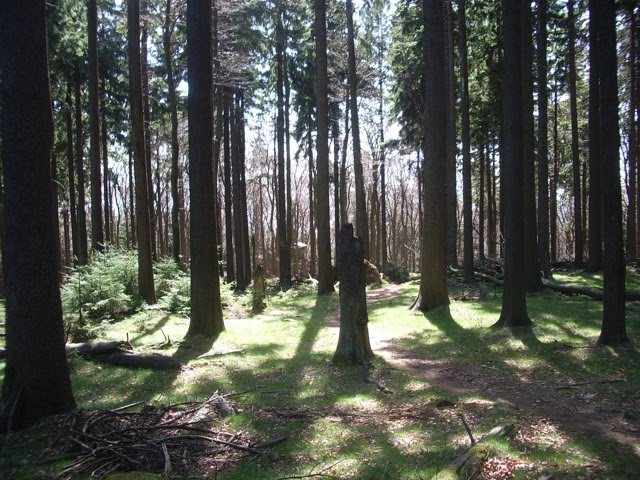
This last photo is of forest not far below the Celtic fortifications. The hike from the trailhead to the top of the mountain was a little more than 2 miles (I think--that is my guess based on our hiking time back to the car) and a climb of about 1000 vertical feet. Much of the trail passed through this type of forest.
Wednesday, December 8, 2010
Frankfurt Holiday photos
I took all of these photos during the past few days in Frankfurt am Main, Germany.
This is part of a window display in the Galleria on the Zeil. All the stuffed animals are moving: the bears sledding, the ducks pulling the sled, and more bears and other animals circling on the ski lift in the back left.
(The Galleria is a great department store with a wonderful bakery, a large chocolate section, a bookstore, and more.)

Downtown Frankfurt. The Römer, Frankfurt's city hall for 600 years, is behind the towering Christmas tree. The tree stands in a large square where part of the Christmas market stands.

I took this next photo in Grüneberg Park.

This is a trail I often walk on here in Frankfurt.

A cafe, open summers, in Grüneberg Park. I like the two snowmen, one standing, one fallen.

I wish the cafe was open in the winter. It would be a great place to grab a cup of hot chocolate and watch the snow fall.
Thursday, June 24, 2010
News and Link Medley
Check out this great, must-read article: The Elephant in the Room by Elizabeth Bluemle. She discusses the need for diversity in books. She gives tons of great links and includes wonderful illustrations, which I have already revisited.
Diversity in children's books is a critical topic of conversation. I believe as a greater variety of books become available (diverse books with illustrations and characters which include all cultures and ALL children) we will create more readers and will increase peace, tolerance and understanding.
Hunger Mountain, the literary journal of Vermont College of Fine Arts, has their newest edition available online. Here is the Young Adult and Children's Literature Issue. There is a wide range of articles as well as fiction and poetry to read.
My semester recently finished and I already miss working with my advisor, Kathi Appelt. This has been an incredible and unforgettable semester. I look forward to seeing her in July when I am at the residency on campus in Montpelier, Vermont.
The World Cup is going on. I see lot of flags flying, mostly on cars. Most cars fly German flags, but many fly two flags--one German and one from the driver's country. (It is more fun if rooting for two or three teams.) My kids have been watching some of the games at school, (during class?) and since their school has kids from all over the world (and from almost all of the countries in the Cup) there is lots of patriotism which exhibits itself with face painting and wearing shirts with their respective countries' flag colors in school. I found it interesting that the World Cup theme song is sung in two languages: Spanish and English.
Vermont College of Fine Arts will have some great visiting authors on campus this summer for residency. Readings by the faculty, visiting authors and graduating students are open to the public. The schedule will be announced before the start of residency in July, and should be available on their website. This is a great opportunity for anyone who is in the Vermont region.
Saturday, June 19, 2010
Out of the Way! Out of the Way! by Uma Krishnaswami
Uma Krishnaswami, my friend and one of the faculty (and my previous advisor) at Vermont College of Fine Arts, recently published a new picture book, Out of the Way! Out of the Way! (The illustrator is Uma Krishnaswamy, the artist--their names have one letter different in English; I want to see more books from her.)
I can't express how excited I am about this book. It is incredible.
Also cool-- it is available in many awesome languages.
 From Uma's blog: "Chaos and cheerful disorder abound in OUT OF THE WAY! OUT OF THE WAY! as a boy, a tree, and a road all grow together."
A delightful, multi-continent blog tour for this book is the happening thing. I'm looking forward to the interviews, videos, and more. The schedule of the blog tour is at Tulika Books blog.
Uma will also post links on her blog, Writing with a Broken Tusk, each day.
Out of the Way! Out of the Way! is available from Tulika Books for $6.50.
Tuesday, May 25, 2010
Syntax (word order) or how to get surprises in a foreign country
Occasionally when I’m speaking in a foreign language, I don’t say what I thought I said.
Yesterday some of my family visited the castle and old city in Bad Homburg.
Here are a couple photos I took:

 We stopped for a snack at a small café just a few meters down the hill from the castle.
I thought I asked for chocolate ice cream. But because I reversed the position of two words I got ice cold chocolate milk, with vanilla ice cream scoops inside it, and whipped cream on top. I was surprised when they brought it out to my table. Eis Schokolade is excellent, so it was a good mistake to make.

Syntax, or where words are placed in a sentence, is critical. It not only changes meaning, but can create voice, atmosphere, and tone. It can also mean that you get an eis schokolade instead of ice cream in a cup.
Subscribe to:
Posts (Atom)


