Showing posts with label applying life to fiction. Show all posts

Tuesday, April 17, 2012

Doors--like the cover of a novel--are an invitation to look inside


 I always wonder what is behind closed doors—especially fascinating and unique doors.

Door in Bruges, Belgium
Art Nouveau entrance in Brussels, Belgium

This long cord makes me want to pull on it and hear what the doorbell sounds like.
Long cord, to left of door, is what one pulls to ring the bell.

Some places don't have doors, but only openings, such as this stick house in Keukenhof Gardens in Holland. It reminds me of the story of the Three Little Pigs.

Stick House--I'm in the photo so you can see the scale
This door leads directly to a canal.
 Photo taken in Bruges, Belgium.

Just like a great cover or opening page of the novel, a door is an invitation to peek inside.

Front of Art Nouveau house in Brussels, Belgium
Detail of door. I'm standing in front.
 Occasionally, we are invited inside when we don't expect the opportunity. The inside can be even more amazing than we could have imagined.

Stained glass windows from inside of house.
The owner of the Art Nouveau house (pictured in the 3 photos above) saw us and invited us into his home! The windows are so clear and almost glow when seen from inside! They are gorgeous!

I took these photos on a recent trip we took to the Netherlands and Belgium. (Neither country is that far of a drive from Frankfurt.)

Tuesday, July 5, 2011

Revising -- through a different lens

A photo-journey about revision:

Revising is like exploring castle ruins: walking through arch after arch, or wandering up towers or down dark tunnels where you can't see a thing, or choosing to take a right or left turn. Explore everywhere. It is okay to get lost. (Actually, it's expected.) That is part of the journey.

German castle ruins

Revising is sometimes like using a sundial on a cloudy day. No shadow to give any clue of the time, and no sun to give any sense of direction.

Wall sundial on the outside of a medieval church (1300s)

Keep eyes open when revising. Notice objects that are not on the trodden path and look for what is not expected. The clues in the manuscript can be the key to unlocking difficulties in a revision. After all, a stone shot by the enemy's catapult can make a very nice garden ornament.

Castle garden with a catapult stone in the foreground


Revising is not only re-envisioning, it is also mixing the very old and the very new.

600 year old houses and the modern day skyscrapers

Enjoy the revision journey. Although revising at times means wandering, getting lost, scrambling in the dark, dealing with the unexpected, and asking question after question while searching for solutions, there are glorious moments when one should pause and enjoy the view.

Castle towers

Thursday, February 3, 2011

Write at Your Own Risk


Altered sign in front of College Hall at Vermont College of Fine Arts.


Changing a couple letters and the angle of the camera totally alters the meaning of a sign which stands at the edge of a skating rink.

Thursday, September 23, 2010

Castle Hunting and photos

For months I have wanted to "find" this castle:


The castle ruin in Konigstein.

I have seen this castle in the distance, on a hill, when driving from my kids' orthodontist to their school. Last Saturday we went "castle hunting" and wandered until we found it. We did not know what it was called or even for sure what town it was until we got there. What a great ruin. I found the fine detailed herringbone pattern in one outer wall intriguing and wondered why the workers took the effort, as I've never seen that before.
It is fun to imagine the castle and its inhabitants hundreds of years ago.

-----

Not a castle, but there are castle-like passageways (both in construction and feel) underneath the waterfall in the center of this photo.


I saw the waterfall and red autumn colors reflecting in a small lake and I thought it would made a great photo.

I took this photo in Palmengarten, a private botanical garden, near where I live. Map here. Sometimes I take my Mac and sit at a table overlooking this view and write. It has many large tropicariums (large greenhouse type buildings with plants) in addition to the large grounds with numerous gardens.

My stories are influenced by places I've lived or visited. I "feel" the place, or a combination or places, (or my memory of the place) when I'm writing and it imbues a type of emotional sensibility into the setting.

Banned Book Week starts soon. I'll post about it with some links, as soon as I've turned my writing in to my VCFA advisor.

Tuesday, May 25, 2010

Syntax (word order) or how to get surprises in a foreign country

Occasionally when I’m speaking in a foreign language, I don’t say what I thought I said.

Yesterday some of my family visited the castle and old city in Bad Homburg.
Here are a couple photos I took:


We stopped for a snack at a small café just a few meters down the hill from the castle.
I thought I asked for chocolate ice cream. But because I reversed the position of two words I got ice cold chocolate milk, with vanilla ice cream scoops inside it, and whipped cream on top. I was surprised when they brought it out to my table. Eis Schokolade is excellent, so it was a good mistake to make.


Syntax, or where words are placed in a sentence, is critical. It not only changes meaning, but can create voice, atmosphere, and tone. It can also mean that you get an eis schokolade instead of ice cream in a cup.

Monday, May 10, 2010

Castles--Exploring Mosel River Valley

I wanted to share a few photos of a recent day trip I took with my family. Some day, I think, perhaps I'll write a story set in a castle.

Thurant Castle. (13th century) This one has a 3 bedroom vacation apartment available, next to the tower on the right. I'd love to stay in this castle for a few days.

Some small plants and flowers grew on the top of the tower. This photo also shows some nice details of the stonework.


These stones now decorating the garden are the same that were used in catapults.


Ehrenburg. (1120) This fortress is just a few miles away from the one above.


Look at the details around this door. The carving in the stone is spectacular. It made me wonder what the castle looked like 300 years ago, when it was still in pristine condition.


Detail of the stone work on the upper tower.

I've been in a few places where there were paintings on the walls and ceilings that were 500-800 years old, that also had tile floors that were at least that old. I imagine that the nicer rooms in these castles were also decorated in a similar manner.

We visited several other castles on the same day we visited these two. But one was undergoing renovations and photos were not allowed inside. One was ruins. And the other, though very old, wasn't nearly as impressive.

What I look for when I go through a castle is unexpected details.
That is also what makes writing and reading fun--the unexpected details of plot, characters and setting.

Friday, February 26, 2010

Frankenstein Castle-- Thoughts on Character and Setting

When I wander, or flaneur-- the more accurate word I learned from Julie Larios (a poet and advisor at Vermont College), I sometimes think about setting and characters; how they are interrelated in story.
A character placed in another setting often means a very different story.
A good writing exercise (as well as an interesting way to get to know your character better) is to place the character in a different setting and write a scene.

Recently I visited Frankenstein Castle ruins which are near Darmstadt, Germany. The castle was built in the 1200's. Additions were added over the centuries; the towers are more recent than the walls and main structure. The castle is now in ruins, but the very small castle chapel (says 1556 in a stone on the outside) is still in good shape. The stunning floor tiles appeared to be from an earlier time period.

Many will connect this castle with Mary Shelley and her Gothic novel, Frankenstein. The castle is not actually connected with Shelley or the story. But the story was in the back of my mind when we wandered. It was a cold, foggy day--perfect atmosphere for visiting ruins.

Here are a few photos:


I wonder what the castle looked like 500 year ago.
It is fun to imagine.

The floor in the chapel

(If you happen to be in Germany for several weeks around Halloween, you could visit Burg Frankenstein for entertainment. (Sorry, the link is in German.) There is a restaurant on the premises, outside the castle walls.)

Place or setting can help build our stories. Setting can mold our characters. In some books setting is a character, such as in my WIP (work in progress). This novel, which is set in Brazil, could not take place in a different place.

Friday, January 1, 2010

2010--Peace and Words

In 2010 I wish
for a more peaceful world.

I think peace and words are linked.
Peace can be destroyed by words.
Peace can be created with words.

Words are powerful.
Words said, words written, stories told can change the way people view the world.

As I write I try to remember that words can create reality.

I hope everyone finds some peace this year, at least in their own lives and perhaps as they escape into a book.

Tuesday, December 9, 2008

Technique and Tone


Technique creates tone.


My years of playing musical instruments and taking lessons taught me the importance of tone.
I know the importance of correct technique--the way I hold my hands, the way I position my body, the way I touch and pluck and manipulate the strings.

The guzheng is a complicated instrument and a challenge to learn.

I learned to tune the guzheng. This is the easy part.
I use picks that I tape (with medical tape) to my fingers.


Yes, these are my fingers. I am holding my hand at a funny angle.

My ear is becoming used to the pentatonic scale.
I am learning a new musical notation. (This is not so easy.)
Every single black speck means something.
All those numbers and dots and lines and squiggles.
I can't read the Chinese, but I can read this music. I can't play this exercise yet--it is toward the back of the book.


If you click on the picture you will be able to see the music more clearly. (The link takes you to a larger photo.)

My guzheng teacher and Chinese teaching methods focus on technique. The first book contains exercises that teach me some (all?) of the ways of creating sound on the guzheng. I am learning rapidly. My teacher allows me to progress as fast as I can, after all I don't need to take the exams like everyone else.

My teacher doesn't speak English.
I don't speak Chinese.
She demonstrates and I imitate. She moves my hands and fingers into the correct positions. This is hard. She is constantly correcting my hand position and with my left hand holding it in the correct position for a whole exercise. And it is hard to keep the open fist position and use the correct plucking technique. Very hard.
I try to hold my hands too close to the strings--I'm supposed to hold them quite far away.

It is hard for my hands to get used to different positions--to get in the habit so it is automatic to move in certain ways.
My left hand struggles--and wants to be in a piano position. The left hand is used on both sides of the bridges--one side to play melody and harmony, and the other side to create vibrato, change the actual note value as in making an A an B or an F an F#, and create sound effects.

I've been taking lessons for over 3 months. I realize that it takes years to learn to play the guzheng well.

The guzheng sounds SO cool.
The songs are very diverse and fun to listen to.
I hope to post a music sample of me playing within the next few months.
I hope to learn to play songs while I live in China. Where else could I find a teacher?


Photo of my Guzheng


Technique and tone are also critical to writing--but I'll let you make the comparisons.

Tuesday, October 21, 2008

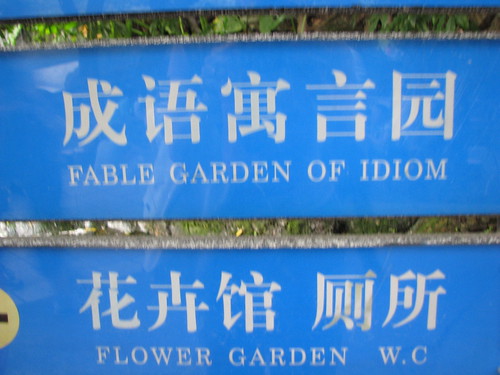
Garden of Idiom

We visited Yuexiu park.


I like this sign.
(Luckily it is also in English.)
The name gives me lots of fun writing ideas. It would be fun to create a fable garden of idiom in a story. What an interesting setting.

I love the settings in stories. Changing the setting changes a story just as much as changing a character will change the story.

This wall is from the Ming Dynasty. (Around 1400)

The ancient tree roots have become one with the wall.


Yuexiu park is huge. It is also very, very crowded. It is hard to explain how crowded the park is. It is hard for me to fathom (even though I was there) how such a huge park (similar in size to Central Park in NYC) can have so many people in it. It was a challenge to take pictures without people in them; the photo of the wall does have a few people.

We became the site to see. People kept counting our kids and whispering to each other, snapping photos of us with their cell phones, and a few people asked (in Chinese and English) if they could have their photos taken with us.

We are fairly noticeable. We were the only foreigners in the park. Plus, we had kids with us! I'll never get used to being stared and pointed at.

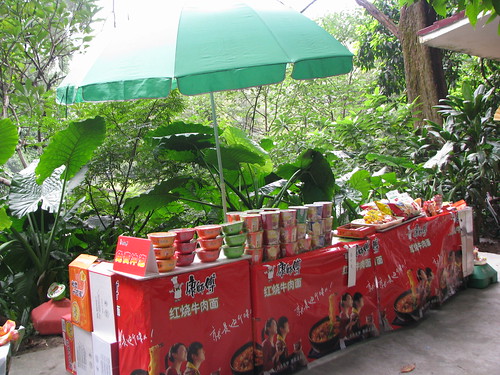
We ate ramen noodles for lunch. We couldn't resist when we saw the ramen noodle stand.


The Chinese parks are beautiful with their walking paths (paved with decorative stones) and lakes and flowers and traditional architecture.

Thursday, October 2, 2008

Danger Working

Danger Working

"Danger working, keep away trom the wall"
This sign is across the alley from the front entrance of my youngest child's school. I'm not sure what the Chinese characters say on the sign.

My imagination went to work.

Is Danger a character?
Or is Danger something else?
Is there a story in this sign?

I want to include Danger in a story I write. The ideas are swirling.

P.S.
Signs like this (or notes from school) are not a rare occurrence. In every country I've lived there are mistranslations. Translating is hard and a native should always read to insure accuracy. I've read papers (in English) for very educated people who realized they need a native speaker to check their grammar and word usage.

Thursday, September 4, 2008

Noticing Details

New places are an opportunity to see fascinating details. But it takes time to see the details.

Each of us notices different details because of our life experiences and who we are. Same with our characters.

I receive a huge onslaught on my senses the first day, (and the first week) when I enter a foreign country. I mostly notice big things, with a few small details that catch my eye. As I adjust I notice more details. My first day here in China--through the mental haze of jetlag--I noticed things like all the green and flowers; some cool architecture in some old, sagging brick buildings towered over by skyscrapers; the cars and taxis zipping in out of traffic--normal big city traffic. I noticed the river we crossed and the yellow apartment building. (Why are we always in a yellow house or building?) I noticed the huge empty feel of an empty apartment, void of everything except basic furniture.


Now I notice different details: things like the pollen falling from the palm trees; a tree with vines growing downward out of the limbs whose vine tips are a lighter color, and if they find soil they will become roots and eventually trees; the gardeners dipping small buckets hanging off 4 foot long poles into water in a wheelbarrow lined with plastic to water hanging plants; the men walking on hanging scaffolding under the bridge--doing repairs; the narrow passageways in some of the markets with the uneven, ancient stone and dirt walkways; the cage-like metal bars around apartment building decks; the laundry hanging outside of windows--inside these cages; green onion cookies (!); bamboo scaffolding that climbs up and up tall skyscrapers.


Photo is of a narrow street in downtown Guangzhou, near Shamian Island. I didn't get a photo of the passageways--but in them I felt like I stepped back 1000 years in time.

The characters in my WIP are entering a new environment. They will notice more details, just as I notice more, as they grow accustomed to a new place. I’m trying to capture the essence of a new place and a new experience. They’ll notice more and more details and understand more of the language with each chapter. The trick is to make their experience feel authentic to my readers.

I love looking for details. Sometimes I wander with my camera and take photos so I can remember things when I'm bombarded by too many details.

Are there any books which use details extremely well? Do you have any favorite books that show characters becoming familiar with an unfamiliar place?

I think details noticed are an essential part of the character voice. Books with a strong voice, tend to have a character who sees details in a way unique to that character and this flavors the entire story.

(Note--I can only see and reply to my blogger. I don't have access to the LJ feed, so if you have a comment please come to http://sarahblakejohnson.blogspot.com/ or send me an email.)

Lost in a taxi

Lost.
There are different types of lost. Sometimes we don't know where we are. And other times we don't know where we are going. I think the worst type of lost is when we have no clue we are lost.

Last night we took a taxi to my older kids' school. It was a back-to-school night where we rush around and listen to all the teachers talk for ten minutes or so. In our case it meant three school schedules (3 kids on this campus) and two parents, so we planned to skip some classes. (Isn't this every kids dream--skip the classes they don't want to attend.)

How did we get lost? The school is in a new area of the city, 45 minutes away. (Guangzhou has about 8-9 million people, so it is a big city.) We drove with some other parents so we could split the fare.

They told the driver where to go--since they speak Chinese. We drove and drove. It is a long way and for a long time the route looked familiar, but then it didn't. The driver slowed down, rolled down his window and while driving at the pace of a bicyclist he asked where Science Park (the technology park where the school is at) is. We wandered more. He asked some people standing under an overpass. We started making phone calls. Of course he didn't have a map and the standard map doesn't go out this far. And we'd left the one decent map at home. He rolled down his window and talked to another driver while we waited at an intersection. We circled some more and he asked more people. The taxi driver was at least in the right section of town, but had no idea where he was or where to go. The 15th or maybe 20th person he asked (in another 30 minutes of driving) knew where Science Park is. We arrived 30 minutes late after 1 1/2 hours in the taxi. At least taxis are cheap here and he didn't charge the full fare which would have been about $20. It should have cost $10--if he'd driven there correctly.

The other couple we went with had arranged for a ride home earlier in the day, since taxi drivers tend to get lost and can't find the school. (This happened to me last time I was at the school. It took me 45 minutes to get a driver--the guards at the entrance called and it took them several calls to get a driver who knew where the school was.)

The funny thing--I wasn't stressed. Five years ago I would have been super stressed. I figured the worst thing would be missing the evening. (I am stressed about other things--like the MFA packet I'm sending to Margaret next week.)

I sometimes get lost when I write. It doesn't stress me like it used to. I know that sometimes a character needs to wander and find out where she is going. I'll revise out the wanderings later. Other times I don't know where I am in the story and that can mean stepping back and looking at the plot, getting to know my characters better and if I'm really lost, asking my writing friends for directions.
We need to be brave and explore our stories and our neighborhoods. And when we get lost--for we will get lost--remember that all will end well. After all, getting lost is part of living.
Thursday, August 28, 2008

Danger Working

Danger Working

"Danger working, keep away trom the wall"
This sign is across the alley from the front entrance of my youngest child's school. I'm not sure what the Chinese characters say on the sign.

My imagination went to work.

Is Danger a character?
Or is Danger something else?
Is there a story in this sign?

I want to include Danger in a story I write. The ideas are swirling.

P.S.
Signs like this (or notes from school) are not a rare occurrence. In every country I've lived there are mistranslations. Translating is hard and a native should always read to insure accuracy. I've read papers (in English) for very educated people who realized they need a native speaker check their grammar and word usage.

Point of View

Point of view makes a difference in how each person approaches life.
I went out for lunch yesterday to meet some of the other women who live in my apartment complex.

I came home wondering why people think I need an ayi-- a woman who cleans, cooks and shops (full time of course), a cell phone (I’m eyeing my husband’s blackberry, but it doesn’t make sense to get one at this time and I’m home almost always anyway), a driver (yes, a driver for a car we don’t own because we won’t buy one here). Their pov is it is impossible to live without an ayi.

I’m not a picky eater. Yet I’m not the bravest with trying new foods either. They raved about how good the restaurant was, oohed and awed over the meals. We each chose an entre--placed the dishes in the center of the table and ate family style. I have a hard time eating things that still look alive. Sorry. I can't do it. The food was interesting, yes, but I had a plateful of food when we finished. At least no one ordered (or the restaurant doesn’t serve) 5 snake soup.

The following are some of the foods I've seen that some think are wonderful, but I hope hope hope to avoid. Anteater, jellyfish, snake, python (I know it is a snake), rat--that is what they looked like, seahorses, caterpillars, turtles, those special eggs that have stuff growing on the outside, the other special eggs and I won’t mention what they contain, and crocodile. (My kids disagree and would try some of the above--my kids ate food in other countries that I wouldn’t eat either.)

I’ve hardly cooked meat since we’ve arrived. I have no desire to eat any meat. Walking through markets AND grocery stores and seeing animals slaughtered is hard on my appetite. Any hints on vegetarian cooking would be appreciated.

It is useful to see such a huge range of viewpoints as I meet so many different people. It helps me create characters who are very different than each other. It reminds me that the most interesting characters have unique characteristics and have reasons for what they do.

There are more ways to view the world than I can imagine.