At risk of embarrassing myself, I am sharing some video clips of me playing the guzheng.
I uploaded them to my flickr--the only place I have available, so I have a time limit. Because of this, I filmed 2 parts of a song.
The camera angle is odd. I look down at my hands while playing and never saw them from the side before.
I used a Canon camera which is designed for photos, but the video and sound quality is okay.
(I didn't know where to upload my other option, which captures higher quality sound, but no video.)
I started lessons last September. So, I've not played this instrument for very long. I've had about 20 lessons. This piece is far from perfect, but does give you a sense of the guzheng.
Here is a post from last December which shows some pictures and gives additional info about the guzheng. There is also a photo of the music, which is very different from Western musical notation.
I was unable to upload the videos. Sorry, I need some major tech help here.
You can see them in on my flickr: beginning of song and end of song. Depending on your internet connection, you might need to hit pause, let the movie load and then hit play.
Enjoy.
Showing posts with label China. Show all posts
Showing posts with label China. Show all posts
Friday, April 24, 2009


Monday, March 2, 2009
School lunches in China
I love reading the elementary school lunch menu my youngest brings home.
We packed school lunches in the past, but because bread, cheese, peanut butter, and the other mainstays of packed lunches are uncommon and expensive here, we now buy school lunches. My youngest has to pre-choose Western Menu or Asian menu for each day of the month.
One interesting thing is that in this area of China (Guangzhou) soup is necessary for a meal to be complete. Soup is served with every lunch option. Also--Lotus is water lily. It actually tastes pretty good.
She attends an international school.
Here are a few examples of meals from the Asian menu:
Here are a few meals from the American menu:
We packed school lunches in the past, but because bread, cheese, peanut butter, and the other mainstays of packed lunches are uncommon and expensive here, we now buy school lunches. My youngest has to pre-choose Western Menu or Asian menu for each day of the month.
One interesting thing is that in this area of China (Guangzhou) soup is necessary for a meal to be complete. Soup is served with every lunch option. Also--Lotus is water lily. It actually tastes pretty good.
She attends an international school.
Here are a few examples of meals from the Asian menu:
- Lotus Root soup, Grilled chicken breast with Ginger and Lemon, Thai Fried Rice, Spinach
- Sea Weed with Egg Soup, Chicken Satay, Vegetable Udon Noodles, Bok Choy and Black Mushroom
- Steamed Rice in Lotus Leave [sic], Winter Melon Soup, Stir Fried Bean Sprouts.
- Lotus Root Soup, Char Kway Teow (Malaysian Fried Noodles), Spring Roll, Chinese Cabbage
- Water Cress Soup, Beef w/Broccoli, Spring Onion Chinese Pancake, Cauliflower
Here are a few meals from the American menu:
- Cream Mushroom Soup, Grilled Duck Breast, Hash Brown, Broccoli and Sweet Corn
- Grilled polenta, pumpkin soup, Mexican fajita, Fish fingers, Snow peas and Cherry tomato
- Russian Soup, Sauteed Beef Cubes, Crispy Potato Ball, Ratatouille
- Broccoli Soup, Mixed Peppers w/Beef Potatoes, Rissoles, Mixed Diced Veggies w/Butter
- French Onion Soup, Roast Pork, Loin Pasta w/Garlic Ratatouille
Saturday, January 3, 2009
Photos from my trip to Northern China
I uploaded some photos from my trip to Beijing, the Great Wall and Xi'an to my flickr. You can see them here.
I'll post a few of my favorites below.


These two pictures were taken at the Great Wall at Ju Yong Guan near Badaling
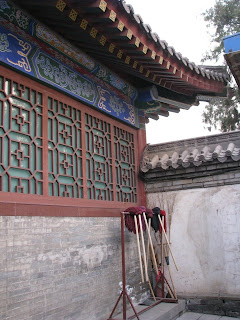
The following picture is a detail of the roof at the Lama Temple in Beijing.

Fried Scorpions, anyone? What about silk worm larva? And more delicacies?
I wasn't brave enough to chomp into one of these. And yes, you eat the whole thing!
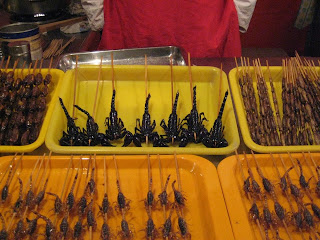
The Temple of Heaven. The first photo is a detail of roof tiles and the next picture is taken from a sacrificial mound looking toward the northern part of the temple complex.


This next photo was taken at the Ming tombs. It is the top of an outdoor balustrade.
The following pictures were taken in/near Xi'an.The first photo was taken on the Goose Pagoda grounds in Xi'an. The next photo is of of bricks that are part of the huge, absolutely huge, ancient wall of Xi'an. They are signed. If a brick broke the maker would be executed. Now that is extreme quality control! (I think if you click on the photo it will be larger.) The last picture is a closeup of some of the Terra Cotta Warriors.


The train ride to Xi'an was quite interesting. We took the night train. There is no privacy because there are no doors to the sleeping compartments--luckily there were 6 of us and 6 bunks arranged 3 high on a side are in one compartment, or we'd have had to share with strangers. The squat toilets open to the track which flies by underneath.
I also enjoyed the Beijing Capital Museum. I'd suggest visiting this museum to anyone who visits Beijing.
I'll post a few of my favorites below.


These two pictures were taken at the Great Wall at Ju Yong Guan near Badaling
The following picture is a detail of the roof at the Lama Temple in Beijing.

Fried Scorpions, anyone? What about silk worm larva? And more delicacies?
I wasn't brave enough to chomp into one of these. And yes, you eat the whole thing!

The Temple of Heaven. The first photo is a detail of roof tiles and the next picture is taken from a sacrificial mound looking toward the northern part of the temple complex.


This next photo was taken at the Ming tombs. It is the top of an outdoor balustrade.

The following pictures were taken in/near Xi'an.The first photo was taken on the Goose Pagoda grounds in Xi'an. The next photo is of of bricks that are part of the huge, absolutely huge, ancient wall of Xi'an. They are signed. If a brick broke the maker would be executed. Now that is extreme quality control! (I think if you click on the photo it will be larger.) The last picture is a closeup of some of the Terra Cotta Warriors.


The train ride to Xi'an was quite interesting. We took the night train. There is no privacy because there are no doors to the sleeping compartments--luckily there were 6 of us and 6 bunks arranged 3 high on a side are in one compartment, or we'd have had to share with strangers. The squat toilets open to the track which flies by underneath.
I also enjoyed the Beijing Capital Museum. I'd suggest visiting this museum to anyone who visits Beijing.
Thursday, January 1, 2009
Bookstores are wonderful places
I love visiting bookstores in every country where I live. A bookstore (Eymundsson's) in Iceland was convenient for me--it was downtown, just a short walk from my home. There was a coffee shop upstairs. Here in China there are many bookstores. Of interest--most books in the US are printed in the region where I live. The bookstores tend to be either small or tinier than one could imagine.
A tiny book store which is about 4 feet wide and 6 feet deep.

I've seen smaller stores here in Guangzhou.
I'm also amazed when I see a bike loaded up with books and magazines. I've even seen bikes used as movable newstands.
I visited a large bookstore when I was in Beijing. Of course I wandered over to the children’s section, which is comparatively small compared to children's sections in US stores, and spent a long time looking at all the titles. There are several children’s books from the US that are translated into Chinese. I didn’t find the Chinese young adult section, even though I’ve seen one in a much smaller bookstore. I exercised little constraint and bought 9 picture books.

These are dual language books (Chinese and English) and are traditional tales. The cost was reasonable, about $3 for each 46 to 64 page long paperback picture book. (About 6 by 9 inches.) I was excited to find Chang’e Flying to the Moon. There are several versions of the story: http://en.wikipedia.org/wiki/Chang%27e. The book I bought is closest to version 1, with some notable differences.
I always like to buy a few picture books in each country. These books tend to be folktales. Since a picture book I’m working on is an adaptation of an American tale (a story I’ve always wished was available in a picture book) I’ve been paying more attention to how writers adapt stories, how they stay true to the story while making it accessible to young children. I adapted this story and two other picture books for my workshop at Vermont College Residency later this month.
This next semester I am taking the picture book concentration. The picture book program is by application (and is also open to non-students for a semester certificate).
Because I will focus on picture books, I will let my latest novel sit and keep my first novel (which is also calling me) company. I finished my first draft of River last semester and over my semester break I cut chapters, divided chapters, moved chapters and did other necessary structural revisions. I'd love to work on it, but letting it rest will allow me to see it with fresh eyes.
I love picture books which is why I wanted to want to explore and learn about the craft of this wonderful genre of children’s books. Because I was accepted to the picture program I already know who my advisor is.
I get to work with Uma Krishnaswami!!!!
She blogs here and Cynthia Leitich Smith (who also teaches at Vermont) has an interview with her here. I am very excited to work with Uma.
I fly to Vermont next week.
I've already made arrangements to buy several books from The Flying Pig Bookstore when they visit campus.
Did I ever mention I love bookstores.
A tiny book store which is about 4 feet wide and 6 feet deep.

I've seen smaller stores here in Guangzhou.
I'm also amazed when I see a bike loaded up with books and magazines. I've even seen bikes used as movable newstands.
I visited a large bookstore when I was in Beijing. Of course I wandered over to the children’s section, which is comparatively small compared to children's sections in US stores, and spent a long time looking at all the titles. There are several children’s books from the US that are translated into Chinese. I didn’t find the Chinese young adult section, even though I’ve seen one in a much smaller bookstore. I exercised little constraint and bought 9 picture books.

These are dual language books (Chinese and English) and are traditional tales. The cost was reasonable, about $3 for each 46 to 64 page long paperback picture book. (About 6 by 9 inches.) I was excited to find Chang’e Flying to the Moon. There are several versions of the story: http://en.wikipedia.org/wiki/Chang%27e. The book I bought is closest to version 1, with some notable differences.
I always like to buy a few picture books in each country. These books tend to be folktales. Since a picture book I’m working on is an adaptation of an American tale (a story I’ve always wished was available in a picture book) I’ve been paying more attention to how writers adapt stories, how they stay true to the story while making it accessible to young children. I adapted this story and two other picture books for my workshop at Vermont College Residency later this month.
This next semester I am taking the picture book concentration. The picture book program is by application (and is also open to non-students for a semester certificate).
Because I will focus on picture books, I will let my latest novel sit and keep my first novel (which is also calling me) company. I finished my first draft of River last semester and over my semester break I cut chapters, divided chapters, moved chapters and did other necessary structural revisions. I'd love to work on it, but letting it rest will allow me to see it with fresh eyes.
I love picture books which is why I wanted to want to explore and learn about the craft of this wonderful genre of children’s books. Because I was accepted to the picture program I already know who my advisor is.
I get to work with Uma Krishnaswami!!!!
She blogs here and Cynthia Leitich Smith (who also teaches at Vermont) has an interview with her here. I am very excited to work with Uma.
I fly to Vermont next week.
I've already made arrangements to buy several books from The Flying Pig Bookstore when they visit campus.
Did I ever mention I love bookstores.
Tuesday, December 9, 2008
Technique and Tone

Technique creates tone.
My years of playing musical instruments and taking lessons taught me the importance of tone.
I know the importance of correct technique--the way I hold my hands, the way I position my body, the way I touch and pluck and manipulate the strings.
The guzheng is a complicated instrument and a challenge to learn.
I learned to tune the guzheng. This is the easy part.
I use picks that I tape (with medical tape) to my fingers.

Yes, these are my fingers. I am holding my hand at a funny angle.
My ear is becoming used to the pentatonic scale.
I am learning a new musical notation. (This is not so easy.)
Every single black speck means something.
All those numbers and dots and lines and squiggles.
I can't read the Chinese, but I can read this music. I can't play this exercise yet--it is toward the back of the book.

If you click on the picture you will be able to see the music more clearly. (The link takes you to a larger photo.)
My guzheng teacher and Chinese teaching methods focus on technique. The first book contains exercises that teach me some (all?) of the ways of creating sound on the guzheng. I am learning rapidly. My teacher allows me to progress as fast as I can, after all I don't need to take the exams like everyone else.
My teacher doesn't speak English.
I don't speak Chinese.
She demonstrates and I imitate. She moves my hands and fingers into the correct positions. This is hard. She is constantly correcting my hand position and with my left hand holding it in the correct position for a whole exercise. And it is hard to keep the open fist position and use the correct plucking technique. Very hard.
I try to hold my hands too close to the strings--I'm supposed to hold them quite far away.
It is hard for my hands to get used to different positions--to get in the habit so it is automatic to move in certain ways.
My left hand struggles--and wants to be in a piano position. The left hand is used on both sides of the bridges--one side to play melody and harmony, and the other side to create vibrato, change the actual note value as in making an A an B or an F an F#, and create sound effects.
I've been taking lessons for over 3 months. I realize that it takes years to learn to play the guzheng well.
The guzheng sounds SO cool.
The songs are very diverse and fun to listen to.
I hope to post a music sample of me playing within the next few months.
I hope to learn to play songs while I live in China. Where else could I find a teacher?

Photo of my Guzheng
Technique and tone are also critical to writing--but I'll let you make the comparisons.
Tuesday, October 21, 2008
Garden of Idiom
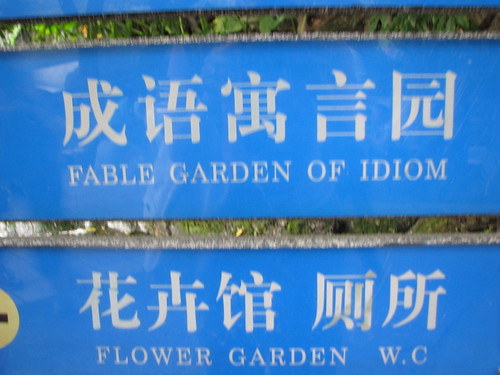 We visited Yuexiu park.
I like this sign.
(Luckily it is also in English.)
The name gives me lots of fun writing ideas. It would be fun to create a fable garden of idiom in a story. What an interesting setting.
I love the settings in stories. Changing the setting changes a story just as much as changing a character will change the story.
This wall is from the Ming Dynasty.
 (Around 1400)
The ancient tree roots have become one with the wall.
Yuexiu park is huge. It is also very, very crowded. It is hard to explain how crowded the park is. It is hard for me to fathom (even though I was there) how such a huge park (similar in size to Central Park in NYC) can have so many people in it. It was a challenge to take pictures without people in them; the photo of the wall does have a few people.
We became the site to see. People kept counting our kids and whispering to each other, snapping photos of us with their cell phones, and a few people asked (in Chinese and English) if they could have their photos taken with us.
We are fairly noticeable. We were the only foreigners in the park. Plus, we had kids with us! I'll never get used to being stared and pointed at.
We ate ramen noodles for lunch. We couldn't resist when we saw the ramen noodle stand.
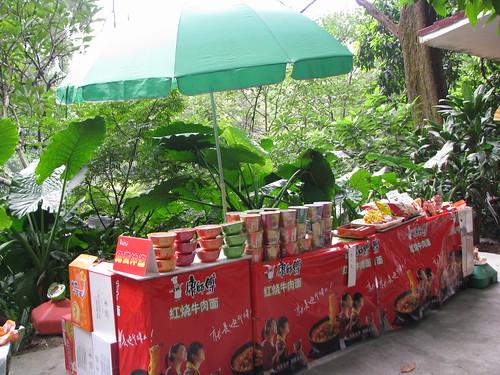
The Chinese parks are beautiful with their walking paths (paved with decorative stones) and lakes and flowers and traditional architecture.
Thursday, October 2, 2008
Danger Working
Danger Working
"Danger working, keep away trom the wall"
This sign is across the alley from the front entrance of my youngest child's school. I'm not sure what the Chinese characters say on the sign.
My imagination went to work.
Is Danger a character?
Or is Danger something else?
Is there a story in this sign?
I want to include Danger in a story I write. The ideas are swirling.
P.S.
Signs like this (or notes from school) are not a rare occurrence. In every country I've lived there are mistranslations. Translating is hard and a native should always read to insure accuracy. I've read papers (in English) for very educated people who realized they need a native speaker to check their grammar and word usage.
"Danger working, keep away trom the wall"
This sign is across the alley from the front entrance of my youngest child's school. I'm not sure what the Chinese characters say on the sign.
My imagination went to work.
Is Danger a character?
Or is Danger something else?
Is there a story in this sign?
I want to include Danger in a story I write. The ideas are swirling.
P.S.
Signs like this (or notes from school) are not a rare occurrence. In every country I've lived there are mistranslations. Translating is hard and a native should always read to insure accuracy. I've read papers (in English) for very educated people who realized they need a native speaker to check their grammar and word usage.
Thursday, September 18, 2008
Broken eggs
My newest goal: Bringing eggs home (in a clear plastic bag) from the wet market a mile away without breaking a single egg.
I manage to break an egg every single time, whether I walk or use my bike.
I buy my fruits and vegetables at this market of little booths--including one egg booth, so I have a pretty decent load to carry. I always put the eggs on top.
We don't own a car and won't buy one while we are living in China. (Lots of reasons for this.)
So we walk or use the bus or taxis. (I could take a taxi home--it would only cost $1, but it really isn't far.)
Maybe I should order one of those backpacking plastic eggholders.
Eggs and how I buy them.
I choose out eggs from a good sized crate full of eggs. I choose from the crate of normal chicken eggs. Then I hold them over a light--Hm--explaining time here. There is a flat horizontal board in the front of the egg booth (at first I assumed it was part of the structure of the tilted table) and egg sized holes are cut out. I flip a switch, turn on a light bulb and check each egg--I'm not sure for what I'm checking and perhaps I don't want to know, but I see other people doing this and I assume if it looks wrong on the inside, it is a bad egg. (I wonder if I'll see (recognize) a bad egg while I'm here)
I place each egg in a plastic netted basket-about 8 inches in diameter. After I hand the plastic basket to the lady, she gently places the egg in a thin bag--like the ones in the veggie section at the store and weighs them. I look at the scale to see how much it costs, because even though I can count in Chinese, it can be hard to understand what they are saying. And I pay. It costs about $1 for 8 eggs.
After I get home, and throw away the egg I broke, I wash the eggs--I always suds them up before I put them away--because, well trust me, they need to be washed.
Trivia--eggs are not refrigerated in most countries.
Today has the worst pollution I've seen here so far. The high humidity makes the large particulates extremely visible: brown-gray, essence of fog, visibility --about 200 meters because I can see (through the haze) the neighboring building and can (kind of) see a silhouette of a skycraper across the way. My eyes feel gritty just biking to and from the market.
It is intriguing how our diet changes so much from one country to the next. In Iceland eggs were extremely expensive and it was a special treat if I made scrambled eggs. (Powdered eggs from the states were cheaper than fresh eggs.) Here, eggs are one of the cheapest food products available.
I manage to break an egg every single time, whether I walk or use my bike.
I buy my fruits and vegetables at this market of little booths--including one egg booth, so I have a pretty decent load to carry. I always put the eggs on top.
We don't own a car and won't buy one while we are living in China. (Lots of reasons for this.)
So we walk or use the bus or taxis. (I could take a taxi home--it would only cost $1, but it really isn't far.)
Maybe I should order one of those backpacking plastic eggholders.
Eggs and how I buy them.
I choose out eggs from a good sized crate full of eggs. I choose from the crate of normal chicken eggs. Then I hold them over a light--Hm--explaining time here. There is a flat horizontal board in the front of the egg booth (at first I assumed it was part of the structure of the tilted table) and egg sized holes are cut out. I flip a switch, turn on a light bulb and check each egg--I'm not sure for what I'm checking and perhaps I don't want to know, but I see other people doing this and I assume if it looks wrong on the inside, it is a bad egg. (I wonder if I'll see (recognize) a bad egg while I'm here)
I place each egg in a plastic netted basket-about 8 inches in diameter. After I hand the plastic basket to the lady, she gently places the egg in a thin bag--like the ones in the veggie section at the store and weighs them. I look at the scale to see how much it costs, because even though I can count in Chinese, it can be hard to understand what they are saying. And I pay. It costs about $1 for 8 eggs.
After I get home, and throw away the egg I broke, I wash the eggs--I always suds them up before I put them away--because, well trust me, they need to be washed.
Trivia--eggs are not refrigerated in most countries.
Today has the worst pollution I've seen here so far. The high humidity makes the large particulates extremely visible: brown-gray, essence of fog, visibility --about 200 meters because I can see (through the haze) the neighboring building and can (kind of) see a silhouette of a skycraper across the way. My eyes feel gritty just biking to and from the market.
It is intriguing how our diet changes so much from one country to the next. In Iceland eggs were extremely expensive and it was a special treat if I made scrambled eggs. (Powdered eggs from the states were cheaper than fresh eggs.) Here, eggs are one of the cheapest food products available.
Sunday, September 14, 2008
Moon Festival
Happy Moon Festival.
This evening is the Mid-Autumn Festival in China. This important holiday is also called the Lantern Festival. We ate mooncakes. We got together with friends, ate, and watched the brilliant, full harvest moon.
Here are some of my kids with their lanterns (not lit--I'm not brave enough to use candles inside fabric lanterns) and masks which they received at a spectacular event ("Mid-Autumn Festival Reception of Chinese Traditional Operas" organized by the government of Guangdong Province) we attended a few nights ago.
 This is as close as I'll come to posting photos of my family online.
I have no idea why they received masks in their gift bags, because I don't think it is part of the celebration. But perhaps it is.
Step outside tonight and look at your moon. I hope your autumn moon is as bright as ours.
Thursday, September 4, 2008
Lost in a taxi
Lost.
There are different types of lost. Sometimes we don't know where we are. And other times we don't know where we are going. I think the worst type of lost is when we have no clue we are lost.
Last night we took a taxi to my older kids' school. It was a back-to-school night where we rush around and listen to all the teachers talk for ten minutes or so. In our case it meant three school schedules (3 kids on this campus) and two parents, so we planned to skip some classes. (Isn't this every kids dream--skip the classes they don't want to attend.)
How did we get lost? The school is in a new area of the city, 45 minutes away. (Guangzhou has about 8-9 million people, so it is a big city.) We drove with some other parents so we could split the fare.
They told the driver where to go--since they speak Chinese. We drove and drove. It is a long way and for a long time the route looked familiar, but then it didn't. The driver slowed down, rolled down his window and while driving at the pace of a bicyclist he asked where Science Park (the technology park where the school is at) is. We wandered more. He asked some people standing under an overpass. We started making phone calls. Of course he didn't have a map and the standard map doesn't go out this far. And we'd left the one decent map at home. He rolled down his window and talked to another driver while we waited at an intersection. We circled some more and he asked more people. The taxi driver was at least in the right section of town, but had no idea where he was or where to go. The 15th or maybe 20th person he asked (in another 30 minutes of driving) knew where Science Park is. We arrived 30 minutes late after 1 1/2 hours in the taxi. At least taxis are cheap here and he didn't charge the full fare which would have been about $20. It should have cost $10--if he'd driven there correctly.
The other couple we went with had arranged for a ride home earlier in the day, since taxi drivers tend to get lost and can't find the school. (This happened to me last time I was at the school. It took me 45 minutes to get a driver--the guards at the entrance called and it took them several calls to get a driver who knew where the school was.)
The funny thing--I wasn't stressed. Five years ago I would have been super stressed. I figured the worst thing would be missing the evening. (I am stressed about other things--like the MFA packet I'm sending to Margaret next week.)
I sometimes get lost when I write. It doesn't stress me like it used to. I know that sometimes a character needs to wander and find out where she is going. I'll revise out the wanderings later. Other times I don't know where I am in the story and that can mean stepping back and looking at the plot, getting to know my characters better and if I'm really lost, asking my writing friends for directions.
We need to be brave and explore our stories and our neighborhoods. And when we get lost--for we will get lost--remember that all will end well. After all, getting lost is part of living.
There are different types of lost. Sometimes we don't know where we are. And other times we don't know where we are going. I think the worst type of lost is when we have no clue we are lost.
Last night we took a taxi to my older kids' school. It was a back-to-school night where we rush around and listen to all the teachers talk for ten minutes or so. In our case it meant three school schedules (3 kids on this campus) and two parents, so we planned to skip some classes. (Isn't this every kids dream--skip the classes they don't want to attend.)
How did we get lost? The school is in a new area of the city, 45 minutes away. (Guangzhou has about 8-9 million people, so it is a big city.) We drove with some other parents so we could split the fare.
They told the driver where to go--since they speak Chinese. We drove and drove. It is a long way and for a long time the route looked familiar, but then it didn't. The driver slowed down, rolled down his window and while driving at the pace of a bicyclist he asked where Science Park (the technology park where the school is at) is. We wandered more. He asked some people standing under an overpass. We started making phone calls. Of course he didn't have a map and the standard map doesn't go out this far. And we'd left the one decent map at home. He rolled down his window and talked to another driver while we waited at an intersection. We circled some more and he asked more people. The taxi driver was at least in the right section of town, but had no idea where he was or where to go. The 15th or maybe 20th person he asked (in another 30 minutes of driving) knew where Science Park is. We arrived 30 minutes late after 1 1/2 hours in the taxi. At least taxis are cheap here and he didn't charge the full fare which would have been about $20. It should have cost $10--if he'd driven there correctly.
The other couple we went with had arranged for a ride home earlier in the day, since taxi drivers tend to get lost and can't find the school. (This happened to me last time I was at the school. It took me 45 minutes to get a driver--the guards at the entrance called and it took them several calls to get a driver who knew where the school was.)
The funny thing--I wasn't stressed. Five years ago I would have been super stressed. I figured the worst thing would be missing the evening. (I am stressed about other things--like the MFA packet I'm sending to Margaret next week.)
I sometimes get lost when I write. It doesn't stress me like it used to. I know that sometimes a character needs to wander and find out where she is going. I'll revise out the wanderings later. Other times I don't know where I am in the story and that can mean stepping back and looking at the plot, getting to know my characters better and if I'm really lost, asking my writing friends for directions.
We need to be brave and explore our stories and our neighborhoods. And when we get lost--for we will get lost--remember that all will end well. After all, getting lost is part of living.
Tuesday, September 2, 2008
Not giving up
Persistence is necessary in both writing and in living in a new country.
Not giving up when things don't go the way we expect. Trying again and again and again. Sometimes trying a different approach.
Living in a new place means trying and sometimes failing. Learning the language. Or enough language for survival. Learning to navigate the streets and discovering where to shop. Not finding what one wants, and searching, knowing the product is somewhere.
Recently, we've been searching for a music store where I could buy a piano. (Our piano was destroyed in the Finland to Iceland move.) I'd love to buy another top quality upright, but with all our moving we wanted a good electronic piano.
We asked people where music stores are and got a vague answer--but enough of an answer to make it worth the hunt. A week ago we went searching for the music store. We went to the mall where it was supposed to be and walked through the most upscale mall here. (Think fancy NYC shopping mixed with the Orient. I saw all the expensive labels I'd only heard of before, plus fancy dried, packaged caterpillars and tea rooms.)
We tried again this past Saturday.
This is what we found as we wandered near a metro stop through winding narrow passages in an underground mall filled with tiny shops no larger than 5 feet by 8 feet.
A Moomin shop! I had to take a photo. For those who have never heard of Moomins, they are all over Finland, made popular by the childrens books by Tove Jansson and are translated into many languages. There is a Moomin shop in Helsinki. Moomins are about the last thing I expected to find in China.
And then we walked across the street.
We entered a modern mall. The mall is similar to what one would find a a big city in the US--seven or eight stories tall, with everything from electronics to clothing to furniture to books to a grocery store.
I've never seen the slanted moving sidewalks (like in airports, but steeply tilted) in the US, but they are in every mall overseas I've been in. The grocery carts have special stops on the wheels so the carts won't roll away while on these sidewalks.
We wandered around a couple blocks in each direction, hoping to find the music store.
We saw this entrance to a park.
 Lots and lots of people, but no one to ask.
No one speaks English.
We flagged a taxi and headed home.
We'd ask again, another person.
We would try again.
Another day.
But on our way back we saw a music store.
"Ting. Ting," (stop) we tell the driver.
We climb out, hoping there are pianos in the store.
Tons of pianos and all types of instruments, just like in a US music store. And luck was with us. A university student who speaks English works in the store on Saturdays ! :)
I took photos of some cool traditional Chinese instruments.
I could have looked longer at the guzheng. They are beautiful. Carvings, inlays, fine workmanship. They've been played for over 2000 years. They sound awesome.

Here are some pipas, essentially a type of lute. The next photo is of Chinese flutes.


After looking at everything in the store (music stores are as much fun as book stores) I chose a piano.
I had eyed the wooden pianos, sorely tempted. But we ended up buying a Yamaha--a super nice one--with a full size keyboard, weighted keys, touch sensitive, great tone. Not the same as my old piano--a great upright with amazing sound and wonderful response to my touch--but extremely nice for an electronic model, as nice as they come.
The interesting thing, in writing as well as in life, thwarted expectations and being forced to explore paths we didn't first see gives new experiences to us and the characters in our stories.
Next Saturday--back to the music store.
I'm going to buy a guzheng and schedule lessons.
Not giving up when things don't go the way we expect. Trying again and again and again. Sometimes trying a different approach.
Living in a new place means trying and sometimes failing. Learning the language. Or enough language for survival. Learning to navigate the streets and discovering where to shop. Not finding what one wants, and searching, knowing the product is somewhere.
Recently, we've been searching for a music store where I could buy a piano. (Our piano was destroyed in the Finland to Iceland move.) I'd love to buy another top quality upright, but with all our moving we wanted a good electronic piano.
We asked people where music stores are and got a vague answer--but enough of an answer to make it worth the hunt. A week ago we went searching for the music store. We went to the mall where it was supposed to be and walked through the most upscale mall here. (Think fancy NYC shopping mixed with the Orient. I saw all the expensive labels I'd only heard of before, plus fancy dried, packaged caterpillars and tea rooms.)
We tried again this past Saturday.

This is what we found as we wandered near a metro stop through winding narrow passages in an underground mall filled with tiny shops no larger than 5 feet by 8 feet.
A Moomin shop! I had to take a photo. For those who have never heard of Moomins, they are all over Finland, made popular by the childrens books by Tove Jansson and are translated into many languages. There is a Moomin shop in Helsinki. Moomins are about the last thing I expected to find in China.

And then we walked across the street.
We entered a modern mall. The mall is similar to what one would find a a big city in the US--seven or eight stories tall, with everything from electronics to clothing to furniture to books to a grocery store.
I've never seen the slanted moving sidewalks (like in airports, but steeply tilted) in the US, but they are in every mall overseas I've been in. The grocery carts have special stops on the wheels so the carts won't roll away while on these sidewalks.
We wandered around a couple blocks in each direction, hoping to find the music store.
We saw this entrance to a park.
 Lots and lots of people, but no one to ask.
No one speaks English.
We flagged a taxi and headed home.
We'd ask again, another person.
We would try again.
Another day.
But on our way back we saw a music store.
"Ting. Ting," (stop) we tell the driver.
We climb out, hoping there are pianos in the store.
Tons of pianos and all types of instruments, just like in a US music store. And luck was with us. A university student who speaks English works in the store on Saturdays ! :)
I took photos of some cool traditional Chinese instruments.
I could have looked longer at the guzheng. They are beautiful. Carvings, inlays, fine workmanship. They've been played for over 2000 years. They sound awesome.

Here are some pipas, essentially a type of lute. The next photo is of Chinese flutes.


After looking at everything in the store (music stores are as much fun as book stores) I chose a piano.
I had eyed the wooden pianos, sorely tempted. But we ended up buying a Yamaha--a super nice one--with a full size keyboard, weighted keys, touch sensitive, great tone. Not the same as my old piano--a great upright with amazing sound and wonderful response to my touch--but extremely nice for an electronic model, as nice as they come.
The interesting thing, in writing as well as in life, thwarted expectations and being forced to explore paths we didn't first see gives new experiences to us and the characters in our stories.
Next Saturday--back to the music store.
I'm going to buy a guzheng and schedule lessons.
Saturday, August 30, 2008
What my children would never learn in the US

My seven year old daughter flagged a taxi today. With confidence.
Is this a normal thing for a child to do?
She better not flag a taxi when I'm not with her.
Thursday, August 28, 2008
Danger Working
Danger Working
"Danger working, keep away trom the wall"
This sign is across the alley from the front entrance of my youngest child's school. I'm not sure what the Chinese characters say on the sign.
My imagination went to work.
Is Danger a character?
Or is Danger something else?
Is there a story in this sign?
I want to include Danger in a story I write. The ideas are swirling.
P.S.
Signs like this (or notes from school) are not a rare occurrence. In every country I've lived there are mistranslations. Translating is hard and a native should always read to insure accuracy. I've read papers (in English) for very educated people who realized they need a native speaker check their grammar and word usage.
"Danger working, keep away trom the wall"
This sign is across the alley from the front entrance of my youngest child's school. I'm not sure what the Chinese characters say on the sign.
My imagination went to work.
Is Danger a character?
Or is Danger something else?
Is there a story in this sign?
I want to include Danger in a story I write. The ideas are swirling.
P.S.
Signs like this (or notes from school) are not a rare occurrence. In every country I've lived there are mistranslations. Translating is hard and a native should always read to insure accuracy. I've read papers (in English) for very educated people who realized they need a native speaker check their grammar and word usage.
Friday, August 22, 2008
Typhoon approaching
Typhoon Nuri (a level 8 storm) will hit my area soon. It is passing over Hong Kong right now. We are inland a bit, so I assume the storm will lessen before it arrives.
My kids are coming home early from school. I just got the phone calls. There are signs posted near the elevators in my building warning us to stay indoors and to make sure drains are clear and windows are shut.
The wind is blowing. The palm trees branches are really moving, but the trunks aren't bending. Not yet. This wind feels like a normal wind in Iceland, but I'm sure it will grow stronger in the next few hours.
We live on an island and I have no idea what a bad storm will do to transportation or to the water levels of the river. Or if we will lose electricity.
Fridge is full and I have a lot in my cupboards. Even so, I'm headed to the store to buy some extra food. Some fun food for my kids.
My kids are coming home early from school. I just got the phone calls. There are signs posted near the elevators in my building warning us to stay indoors and to make sure drains are clear and windows are shut.
The wind is blowing. The palm trees branches are really moving, but the trunks aren't bending. Not yet. This wind feels like a normal wind in Iceland, but I'm sure it will grow stronger in the next few hours.
We live on an island and I have no idea what a bad storm will do to transportation or to the water levels of the river. Or if we will lose electricity.
Fridge is full and I have a lot in my cupboards. Even so, I'm headed to the store to buy some extra food. Some fun food for my kids.
Subscribe to:
Posts (Atom)


